7 min read

Salla Blog
Salla Growth Team

Are you dreaming of owning an e-commerce store packed with customers and high profits?
You can definitely have this store, but only after following the right steps to start your e-commerce journey.
The very first step is to think carefully about the most important question for a beginner merchant:
How much capital do I need to start my journey?
Many believe that owning a successful e-commerce store requires a massive fortune, but the reality is that success is not measured by the size of the capital, but by the intelligence of the merchant.
For example, Ahmed is an ambitious young man, passionate about selling handmade products online. His capital was limited, but he invested it wisely in buying simple jewelry-making tools and creating a modest e-commerce store on a free platform. Over time, he focused on the quality of his products and marketed them smartly on social media, attracting a solid segment of customers, and turning his modest online store into a flourishing commercial entity.
Therefore, a lack of capital is not the obstacle to your e-commerce success; rather, it is the key to your creativity. The journey of a thousand miles begins with a single step, and determining the appropriate capital and managing it wisely is the first step toward this success.
The reality is more beautiful than you imagine
There are no complex conditions for capital in the e-commerce world. You can start your project with limited capital, and recycle its profits into product development and marketing to grow gradually. Based on our experience, we would love to share with you a glimpse of the 3 most prominent things you need to know to start e-commerce:
You must realize that capital in e-commerce differs from the capital required in traditional commerce. You do not need real estate or a large warehouse; most of your costs revolve around developing a professional website and an effective marketing strategy.
There are many financing options available to e-commerce entrepreneurs, such as bank loans, microfinance, and crowdfunding. Each option has its pros and cons, so you must study them carefully before making your decision.
Half of your success is linked to having a detailed study of the costs of setting up and operating your project. This includes the costs of digital marketing, storage, shipping, packaging, and operations. Once you define these costs accurately, you will be able to set a realistic budget for your project.
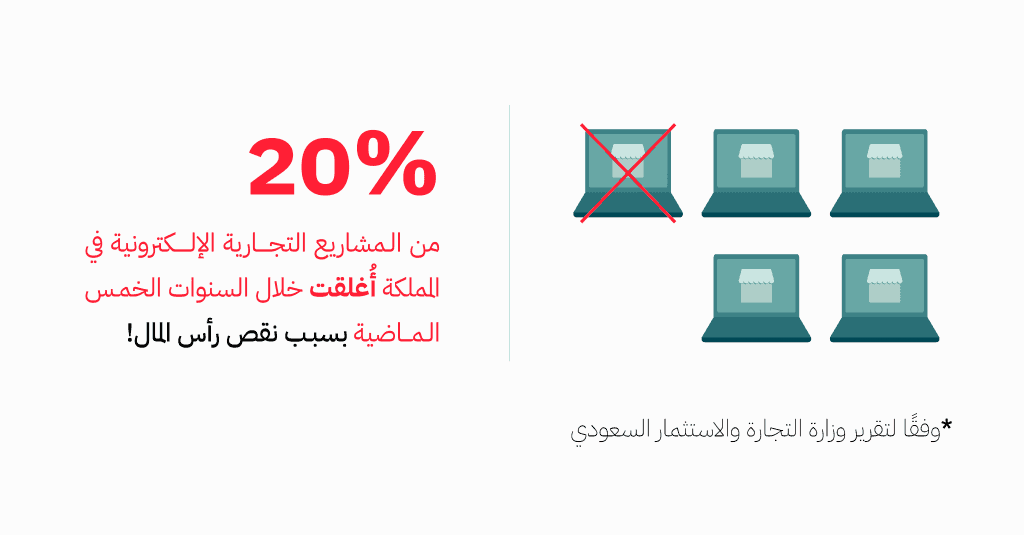
From this statistic, you surely asked yourself: "Is it necessary to define a specific capital to start my business?" Absolutely, this step significantly reduces the obstacles to your project's success. Here are 5 convincing reasons why:
1- Financial Planning and Sustainability
Determining the required capital helps you in proper financial planning for your project in the long term.
Saving 6-8 months of your salary reduces challenges and assists you with sound planning methods.
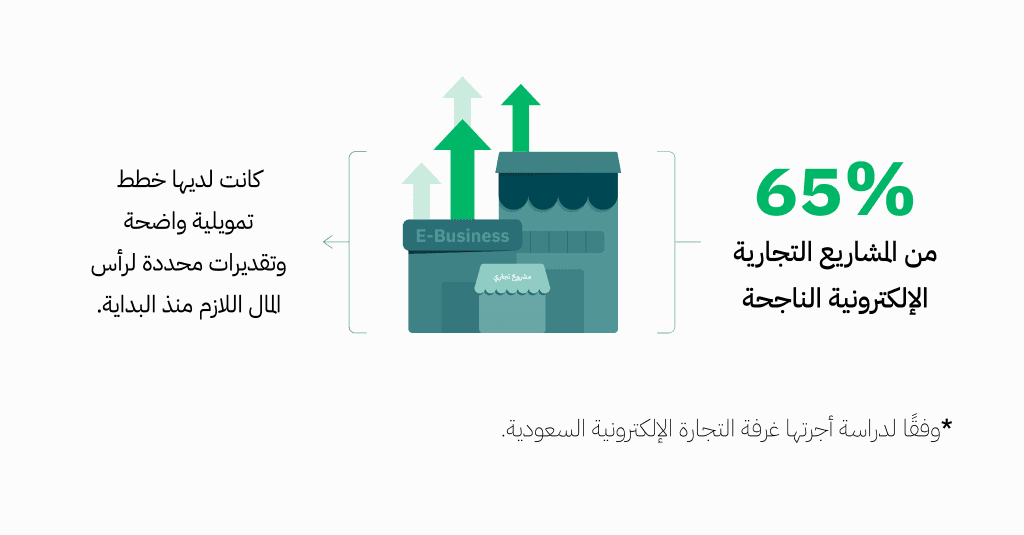
2- It is important to identify your sources
Identifying good funding sources helps you secure suitable financing from various sources such as bank loans or self-investments built among friends and family.
3- Putting everything in its proper place
Allocate your budget appropriately and schedule it across your various costs and expenses.
If you give everything its due, you will not overspend on certain expenses at the expense of others.
4- Risk and Emergency Management
It helps in providing a financial reserve to face crises and unexpected challenges.
Your project will survive and continue even if it faces financial difficulties. Statistics from the Small and Medium Enterprises General Authority (Monsha'at) showed that projects that started with sufficient capital—based on the nature of their activity—were up to 82% more sustainable and capable of growth and expansion compared to projects that started with inadequate capital.
5- Evaluating Economic Feasibility
It helps in conducting an accurate analysis of the feasibility of your project and its potential for success.
It facilitates your decision-making process regarding starting your project or investing in it.
Essentially.. in numbers: how much capital is suitable to start?
We agreed from the beginning that a lack of capital is never an obstacle to starting, and now we will also agree that there are influential factors that govern our giving you approximate numbers, such as:
Type of your business activity: Determining the type of products or services you will sell online.
Size of your e-commerce store: Expected inventory size and the number of your displayed products.
Your marketing channels: Marketing and advertising costs to attract your customers.
Technology: Costs of building and developing an e-commerce store, and e-commerce management software.
Operational activities: Costs of warehousing, shipping, and customer service.
Here are some approximate numbers for the appropriate capital, which varies as we mentioned earlier depending on the previous factors. We also emphasize the importance of conducting a comprehensive feasibility study to determine your financial needs accurately; to ensure you take into account all expected expenses—including operating, marketing, and development costs—and to verify your suitable sources of financing:

1. Starting an e-commerce business without inventory (Dropshipping or Affiliate Marketing):
Required capital: SAR 5,000 - 10,000.
Includes: costs of setting up an online store, platform subscriptions, marketing, and customer services.

2. A small e-commerce store with limited inventory:
Required capital: SAR 15,000 - 50,000.
Includes: the above, plus the cost of purchasing products, storage, and shipping.

3. A medium-sized e-commerce store with product variety:
Required capital: SAR 50,000 - 100,000.
Includes: the above, plus costs for developing a more advanced store, expanding marketing campaigns, and hiring employees.

4. A large e-commerce store with a wide range of products:
Required capital: SAR 100,000 and above.
Includes: all of the previously mentioned costs, plus larger investments in technology, marketing, and branding.
How does Salla help you reduce your capital?
There is no doubt that we are very delighted with every new merchant on our platform, and we gladly work to help their business grow more day by day, through the easiest solutions for entrepreneurs wishing to start e-commerce projects in Saudi Arabia, including:
Our training courses: Educating entrepreneurs on the best e-commerce practices to increase their profits.
Our competitive pricing: Monthly packages that suit all entrepreneurs' needs, starting from the free package.
Our free features: Setting up an online store, payment gateway, and data analysis tools.
Our awesome technical support: Free assistance in all steps of creating and managing online stores.
An integrated community: Of successful merchants who can help you overcome your challenges and reduce your risks.
With Salla Platform
Start your e-commerce project smartly and at the best prices!

We also give you some effective ways from our experts to reduce your capital as much as possible, for example:
Starting an e-commerce business without inventory: "Dropshipping" or "Affiliate Marketing".
Leveraging ready-made e-commerce platforms: like our platform.
Promoting your online store for free: using social media and content marketing.
Participating in supportive programs for entrepreneurs: such as the "Badir" program by the Ministry of Communications and Information Technology.
From one geographical region to another.. Does defining the appropriate capital to start my business differ?
Of course it differs! And here are a few convincing reasons:
1. Operating Costs:
Rent, salaries, and logistics costs vary significantly between major cities and rural areas. For instance, the cost of renting a store in Riyadh is much higher than renting a store in a smaller city like Hail.
Similarly, employee wages in major cities are higher than wages in rural areas.
And do not forget shipping and delivery costs, as the cost of shipping products to remote areas is usually higher than shipping them to areas close to the distribution center.
2. Consumer Purchasing Behavior:
It is natural to notice different buying habits and consumer behaviors between each province or governorate in Saudi Arabia.
What do we mean?
This means a consumer in major cities might be more willing to buy electronic products than a consumer in rural areas. Also, they might prefer buying certain types of products (which others might consider unusual or unconventional) more than others, simply because they find them useful.
3. Competition:
The intensity of competition in the e-commerce sector varies from one region to another. For example, competition in major cities is much fiercer than in smaller areas; this, of course, affects your potential profit margin, and subsequently = will affect the capital you need to start your business.
Salla, the future of e-commerce, an easy platform to start your business

Salla Blog
Salla Growth Team
189
Article
Featured author

Pricing
Product Pricing: With Professional Pricing Tools and Strategies
How do you price your products and what is its impact on your business? After covering in detail how to create an online store, we will show here in this article how to price your products—whatever type of product you sell—...
12 minutes read
Salla Blog

Pricing
Dear merchant, product pricing is no longer an obstacle.
Dear merchant, you have reached this page looking for how to price a product, and you likely realize how difficult the decision to choose the optimal price for your product is, given the prevailing law of supply and demand;...
8 minutes read
Salla Blog
Pricing
<strong>There is no perfect capital to start your business</strong>
Dreaming of owning an online store bustling with customers and highly profitable? You can definitely have this store, but only after following the right steps to start e-commerce.…
7 minutes read
Salla Blog